Board-on-Board Fence Installation: Full Privacy That Stays Closed as Wood Shrinks
A board-on-board fence overlaps its pickets in two layers so there is never a gap to see through, even after the wood dries and shrinks. It is the right choice for homeowners who want complete privacy from a wood fence and are willing to pay for the extra lumber.
Two Layers of Pickets, No Gaps
On a board-on-board fence, the first layer of pickets is fastened to the rails with a space between each board. A second layer is then fastened over the top, with each picket centered on a space and lapping onto the boards on both sides.
The overlap is the point. Every wood picket shrinks across its width as it dries. On a side-by-side fence that shrinkage becomes a visible crack between boards. Here the boards can shrink and the lap still covers the joint, so the fence stays closed. The layered face also gives the fence depth and a pattern of shadow lines that a flat privacy fence does not have.
Board-on-Board Fences: Specifications
| Typical height | 6 ft, taller where permitted |
|---|---|
| Picket layout | Two overlapping layers on one face |
| Orientation | Vertical or horizontal |
| Privacy | Full, from every angle |
| Relative lumber use | Well above a side-by-side fence |
| Common upgrades | Cap and trim, steel posts, cedar pickets |
Best Uses for Board-on-Board Fences
- Complete privacy with no sightlines
- Yards beside a pool, spa or patio
- Homes close to the neighboring house
- Owners replacing a fence that gapped
- Lots along busy streets
Vertical or Horizontal Board on Board
Most board-on-board fences run the pickets vertically, and from the street they look like a heavier, more detailed version of a standard privacy fence. A cap board along the top is a common addition because it covers the stepped edge where the two layers meet. Because the second layer hides the joints in the first, small differences in board width or a slightly crooked picket are far less noticeable than they would be on a single-layer fence.
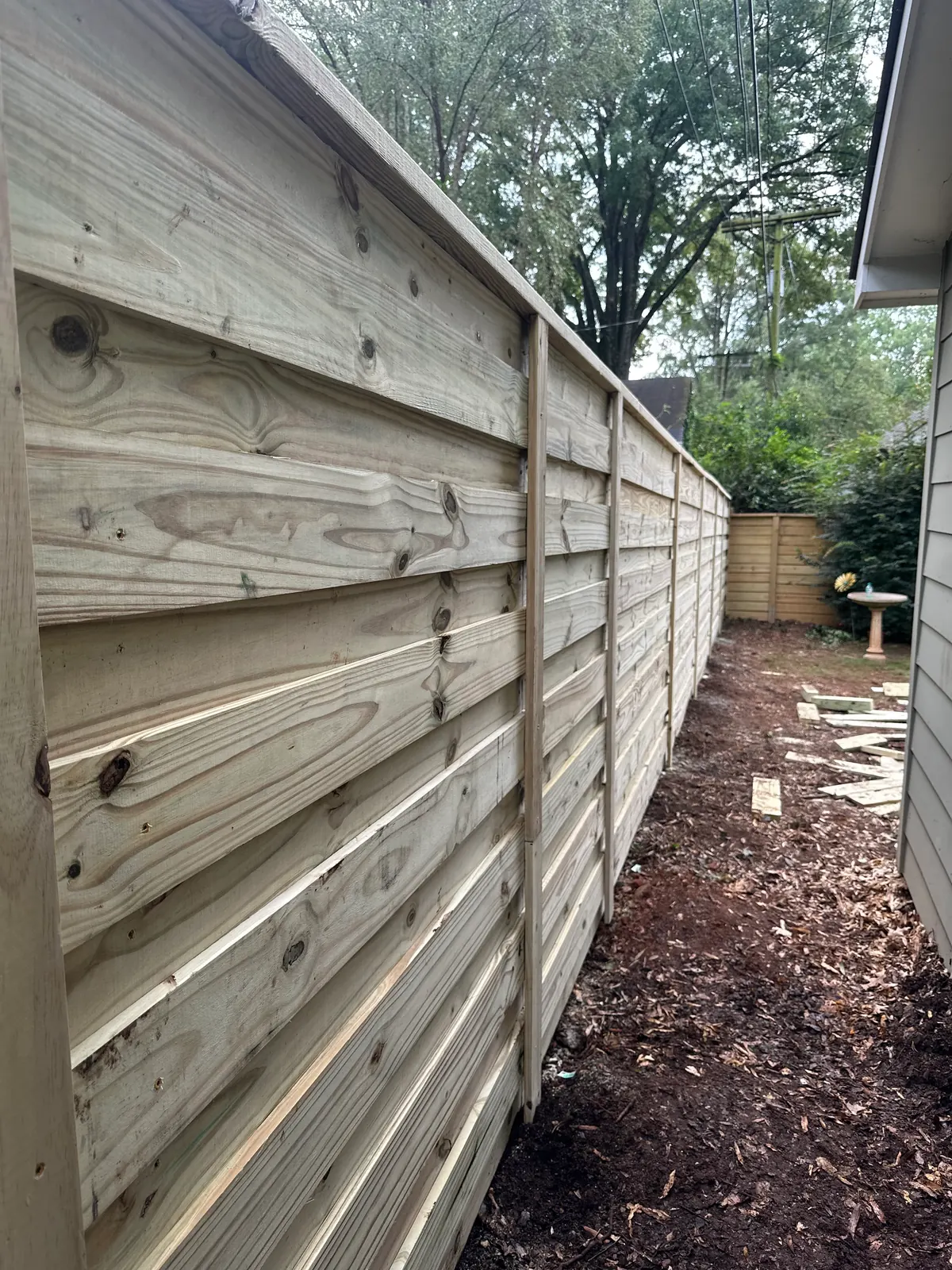
The same overlap works with the boards turned sideways. Our job photos include a 6 ft horizontal board-on-board fence, which pairs the modern look of horizontal lines with full privacy. Horizontal versions need posts set closer together and a frame that keeps long boards from sagging, so they are priced differently from vertical ones. We can show you photos of both before you decide.
Our Board-on-Board Installation Process
Board on board is a heavy fence, and the frame has to be built for it. After the line is confirmed and utilities are marked, posts go in concrete. We size the rails and post spacing for the load, because a fence carrying close to twice the usual picket weight will sag on an undersized frame.
The back layer is hung first with a spacer block so the gaps are uniform. The front layer follows, each picket lapped evenly on both sides. We keep the lap generous enough that the joint stays covered after the lumber has finished drying. Gates on this style are heavy, so they get steel hardware and bracing sized to match.
Signs It Is Time to Replace With Board on Board
People usually come to this style after living with a fence that opened up. If your current privacy fence shows daylight between every board, or the pickets have cupped and pulled their fasteners, new pickets of the same type will do the same thing in a few years.
A replacement job covers removal of the old fence and its footings, disposal, and a new frame on new holes. It is also the moment to fix what bothered you about the old fence: move a gate, add height where a neighbor's deck looks in, or switch to steel posts. We do not recommend hanging a second layer of pickets on an aging frame. The old posts were never set for that weight.
Why Overlap Matters in Piedmont Weather
Charlotte summers are wet and humid and the fall is often dry. Wood swells and shrinks through that cycle every year, and pressure-treated pine in particular arrives from the yard holding a lot of water. A fence that looks tight in May can show gaps by October. Overlapped pickets absorb that movement without changing how the fence looks.
The trade-off is wind. A board-on-board fence is a solid wall, and storm gusts load the posts fully. In red clay that softens when saturated, post setting is what keeps the fence standing straight. On properties in Mecklenburg, Cabarrus, Gaston and York counties with open exposure, we may suggest steel posts for this style.
Weight, Lumber Count and What Drives the Quote
Expect a board-on-board fence to cost more than a dog-ear fence of the same length and height. The reasons are plain: it uses considerably more pickets, the frame is heavier, and hanging two aligned layers takes longer.
Within the style, the main variables are height, the amount of overlap, whether you add a cap and trim, pine versus cedar pickets, wood versus steel posts, and how many gates there are. Grade matters too, since a steep or rocky line takes more labor. We measure on site and put the options side by side in a written estimate so you can see what each choice does to the total.
Board-on-Board Fences: Photos From Our Jobs
These are our own installs. See more in the fence installation photo gallery.
Questions About Board-on-Board Fences
What is the difference between board on board and shadowbox?
Both use two rows of pickets. Board on board puts both rows on the same face of the rails, overlapped, so the fence is fully closed. Shadowbox puts one row on each face with the rails between them, which leaves an angled air path and a partial view from the side. Board on board is the more private of the two.
Does a board-on-board fence look the same on both sides?
Not in its standard form. One side shows the layered pickets and the other shows the rails and posts. If you want the layered look on both faces, pickets can be added to the back as well. That raises the lumber count and the weight again, so we would talk through the frame with you first.
Will gaps ever open up in a board-on-board fence?
They should not, if the lap is sized correctly. The pickets will still shrink as they dry, but the overlapping board covers the joint. That is the main reason people choose this style. A badly warped or split picket can still open a spot, and a single board is simple to swap.
How much more lumber does board on board take?
It depends on the overlap, but plan on substantially more pickets than a side-by-side fence of the same length, plus a heavier frame to carry them. That is the bulk of the price difference. We work out the exact count from your measurements and show it in the estimate.
Can you build a horizontal board-on-board fence?
Yes. We have built 6 ft horizontal board-on-board fences in the Charlotte area. The boards run sideways in two overlapped layers between posts that are set closer together than on a vertical fence. It gives the horizontal look without the thin gaps that a single-layer horizontal fence develops over time.
Is board on board worth it over a regular privacy fence?
If small gaps between boards would bother you, yes. If you mainly want to keep a dog in and mark the yard, a standard dog-ear fence does that for less. We are happy to quote both for the same fence line so you can compare the numbers before choosing.
Related Fences and Services
- Shadowbox Fences
- Horizontal Fences
- Dog-Ear Fences
- Wood Fences With Metal Posts
- Privacy Fencing Installation
- Residential Fence Replacement
Areas We Serve
QC Fence Contractors installs and replaces fencing across the Charlotte metro in North Carolina and South Carolina. Pick the area closest to the property:
- Fence contractors in Belmont, NC
- Fence contractors in Huntersville, NC
- Fence contractors in Charlotte, NC
- Fence contractors in Matthews, NC
- Fence contractors in Ashbrook, NC
- Fence contractors in Harrisburg, NC
- Fence contractors in Concord, NC
- Fence contractors in Rock Hill, SC
- Fence contractors in Ballantyne, NC
- Fence contractors in Gastonia, NC
Listed under Wood Fence Styles in our full list of fence types we install.
Free Estimate: Board-on-Board Fences
Tell us about the property and what you want the fence to do. Or call (833) 691-3387.