Farm Fence Installation: Perimeter and Cross Fencing for Charlotte Area Acreage
Farm fencing is the perimeter and interior fencing that marks a rural boundary, holds animals, and divides pasture into usable fields. QC Fence Contractors builds it for landowners with acreage around Charlotte, from a few fenced acres behind a house to working pasture in the surrounding counties.
What a Farm Fence Has to Do on Charlotte Area Acreage
A farm fence is judged by the foot, because there are a lot of feet. A subdivision backyard might need 200 feet of fence. A ten acre tract can need well over half a mile once you add the interior lines. That changes how the fence is designed. The material has to be affordable over long runs, the posts have to go in fast and stay put, and the wire has to hold tension for years without someone walking the line every month.
Before we quote, we ask what the fence is for. A boundary fence along a road is a different job from a paddock for two horses or a lot for goats. The answer decides the wire, the height, the post spacing and where the gates go.
Farm Fencing: Specifications
| Typical height | 4 ft to 5 ft, depending on the animals |
|---|---|
| Common wire | Woven wire, no-climb mesh, high-tensile, barbed |
| Posts | Pressure-treated wood, steel T-posts, or a mix |
| Corners | H-braced wood assemblies |
| Gates | Tube farm gates, single or double, sized for equipment |
| Service area | Charlotte metro, NC and SC |
Best Uses for Farm Fencing
- Boundary fencing on rural tracts
- Dividing pasture for rotational grazing
- Hobby farms with mixed animals
- Road frontage that needs to look finished
- Replacing sagging or rusted field fence
Perimeter Fence and Cross Fence Are Two Different Jobs
The perimeter fence is the one that matters most. It keeps your animals off the road and off the neighbor's land, and it keeps stray dogs and wildlife out. We build perimeters heavier than anything inside them: closer post spacing, taller wire, and braced corners at every change of direction.
Cross fencing divides the inside of the property into pastures, lanes and holding areas. It lets you rotate grazing, rest a field, or separate animals. Because a cross fence only has to turn an animal that is already contained, it can often be lighter and cheaper per foot than the boundary. We lay out cross fences around water, shade and gate access so that moving animals from one field to the next does not mean walking them across the whole farm.
Farm Fence Types We Build
Most farm jobs around Charlotte use one of these, or a mix of them on the same property.
- Woven wire field fence on wood or steel posts, the general purpose choice for mixed livestock.
- No-climb mesh with a top board, used where horses, foals or dogs are involved.
- Board fence in three or four rails, common along road frontage and around the house.
- High-tensile smooth wire, which covers long distances with fewer posts.
- Barbed wire in multiple strands for cattle on larger tracts.
- Split rail with welded wire backing for small hobby farms that want the fence to look good from the driveway.
How We Install Farm Fencing
Layout comes first. We walk the line with you, flag corners, gates and low spots, and confirm where the property line is. If the boundary is not clearly marked, a survey is worth having before a permanent fence goes on it. Brush along the fence line needs to be cleared wide enough to work in, and we will tell you at the estimate whether that is part of our scope or something to handle ahead of time.
Corners and ends are built next, because every foot of wire pulls against them. We set large corner posts deep and tie them into H-braces with a horizontal rail and a diagonal brace wire. Line posts follow at a spacing matched to the wire. Then the wire is unrolled, stretched with a puller until the tension is right, and fastened so it can still move a little with temperature. Gates go in last, hung on posts sized for the gate width so they do not sag after a season of use.
Replacing an Old Farm Fence
Old farm fence fails in a predictable order. Corner braces loosen first, the wire goes slack, and then animals start leaning on it and pushing under it. Wood posts rot at ground level and snap when pushed. Wire rusts through where it touches wet ground or where vines have held moisture against it for years.
If the corners are sound and only the wire is done, we can sometimes restretch or rehang new wire on existing posts. More often the posts are the same age as the wire and the better money is a full replacement. That means cutting out and hauling off the old wire, pulling or cutting the posts, clearing the regrowth along the line, and building new from the corners out. Replacement is also the time to fix what never worked: a gate in the wrong place, a line that runs through a wet spot, or a pasture that needs to be split.
Red Clay, Rolling Ground and Rural Lots Around Mecklenburg County
Most farm work in this area sits outside the city: northern Mecklenburg, Cabarrus and Gaston counties, Union County to the southeast, and York County across the state line. The ground is Piedmont red clay over rock, and it rolls. Clay grips a driven post well, but it is hard to dig when dry and it holds water after rain, which is rough on untreated wood. We use posts rated for ground contact and expect to hit rock on some holes.
Rolling ground matters for wire. A fence that crosses a dip will lift out of the ground under tension unless the low post is anchored, and a creek crossing needs its own plan. Zoning rules for fences and animals differ between the counties and towns, so check what applies to your parcel before finalizing a layout.
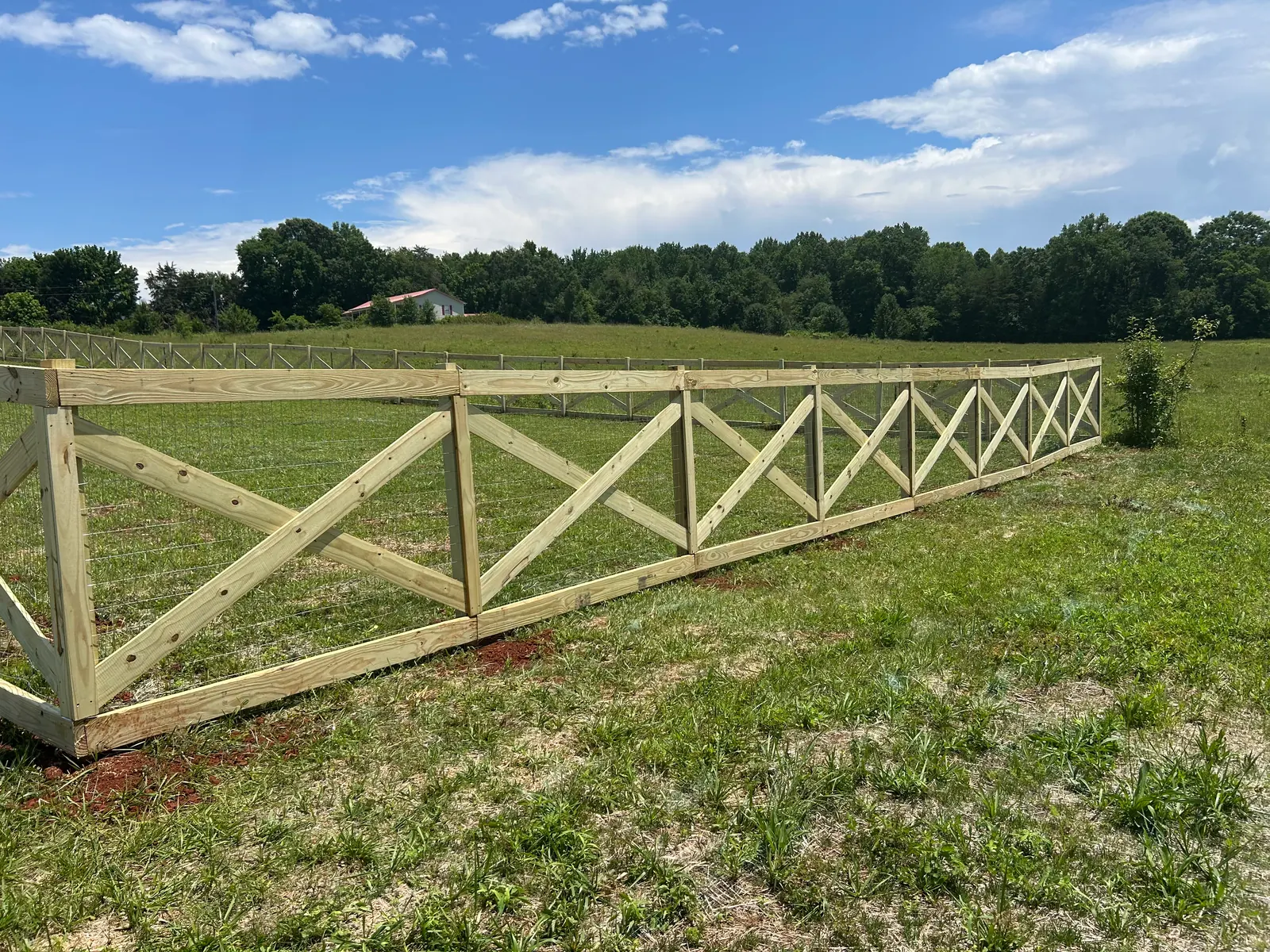
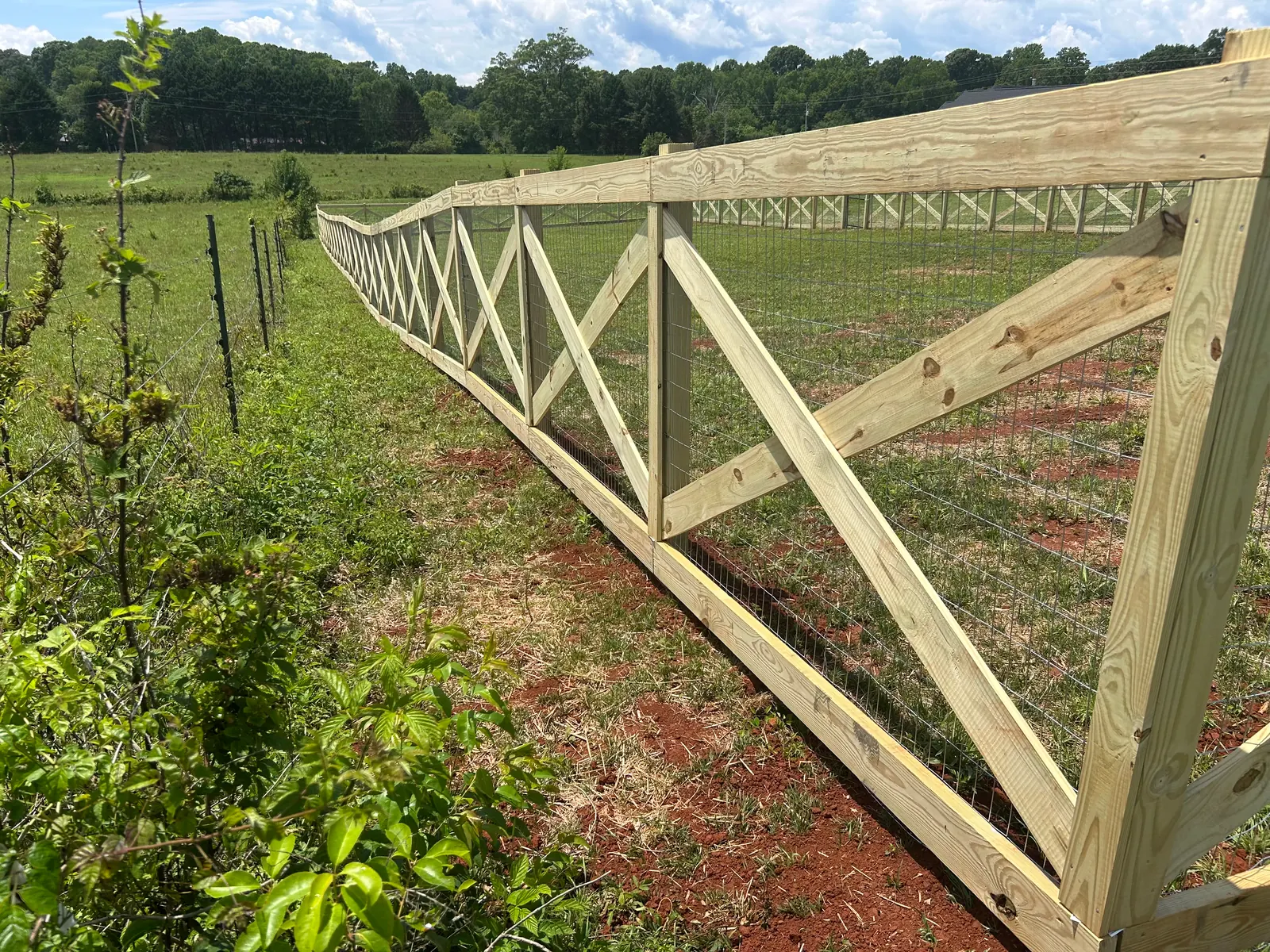
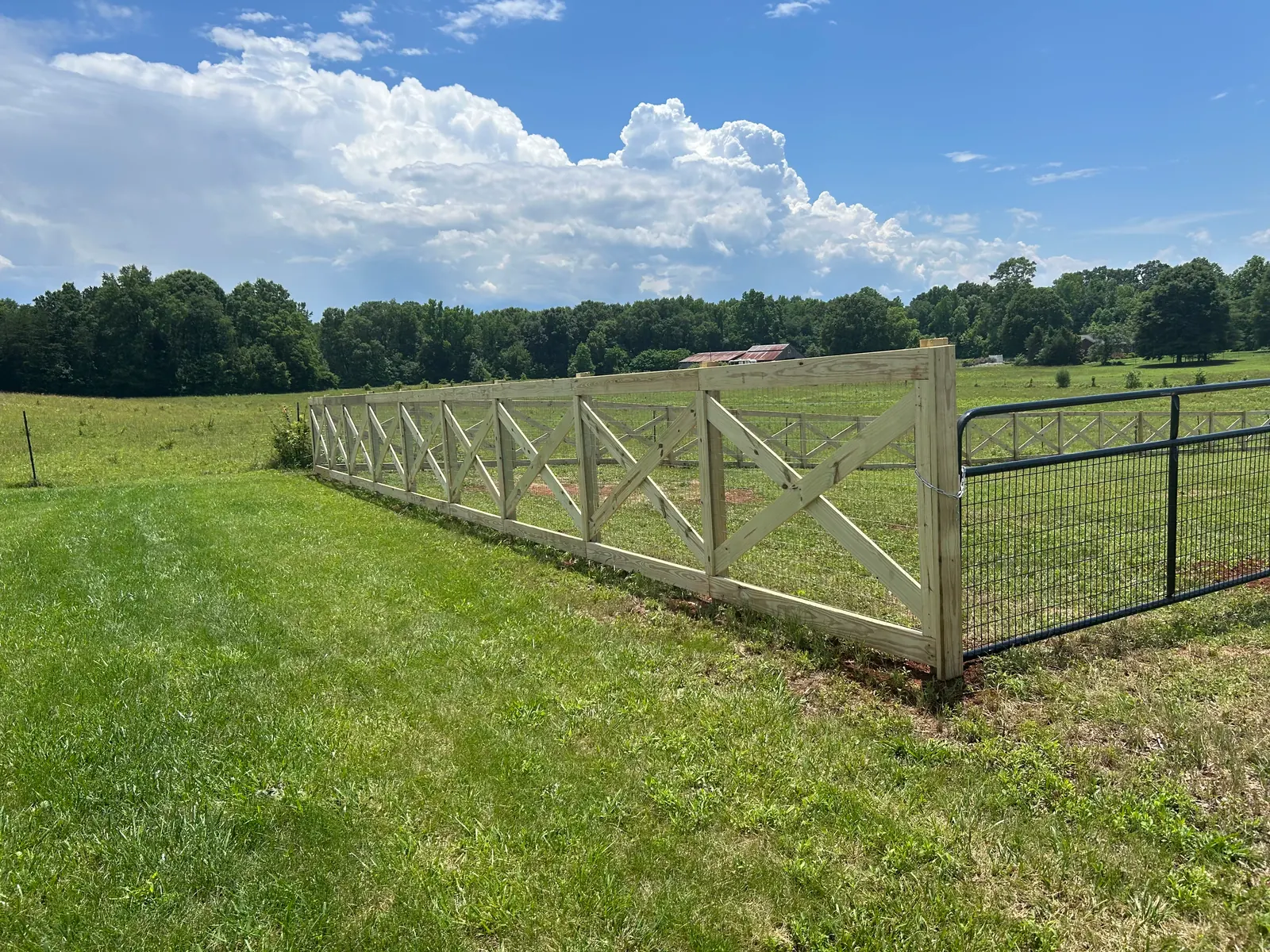
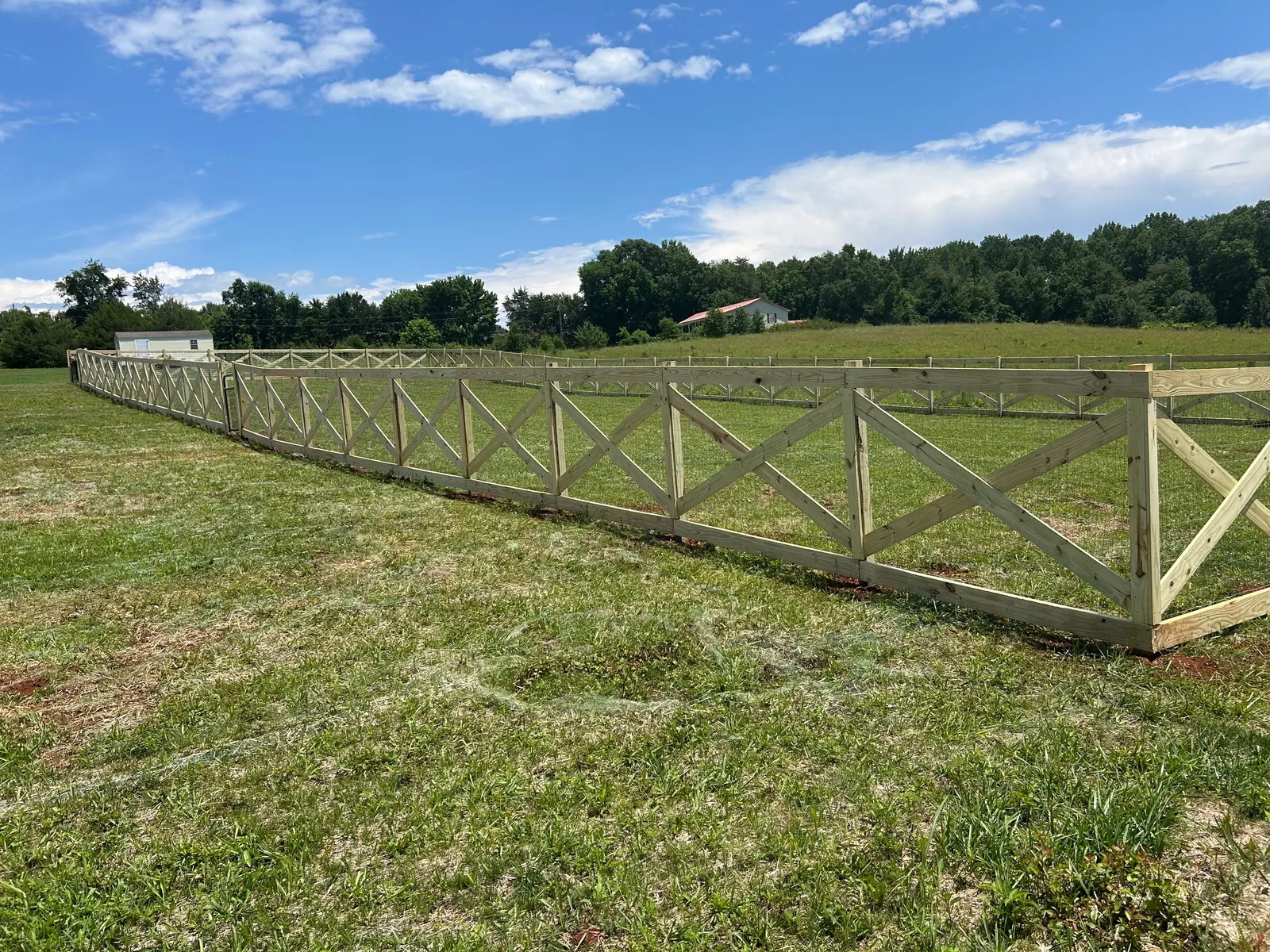
Farm Fencing: Photos From Our Jobs
These are our own installs. See more in the fence installation photo gallery.
Questions About Farm Fencing
What is the best type of fence for a small farm near Charlotte?
For a small farm with mixed animals, woven wire on treated wood posts is the usual starting point because it turns most livestock and lasts well. If horses are part of the picture we move to no-climb mesh with a top board. If looks along the road matter, board fence or split rail on the frontage with wire elsewhere keeps the budget in line.
How far apart should farm fence posts be?
It depends on the wire. Woven wire is commonly set on posts 8 to 12 feet apart. High-tensile wire can span much farther between line posts because the tension does the work. Board fence needs a post every 8 feet so the boards land on center. Rolling ground and heavy animal pressure both call for closer spacing than flat, quiet pasture.
Do you install farm gates?
Yes. We hang tube gates for pasture access and can set double gates where equipment or trailers need to pass. Tell us the widest thing that has to fit through, including a mower deck or a hay trailer, and we will size the opening to it. For a gated driveway entrance we also install automatic gate operators.
Can you fence only part of my property?
Yes. Many landowners start with the perimeter or with one pasture and add cross fencing later. If you think you will expand, tell us at the estimate. We can place braced corners and gate openings now where future lines will tie in, which avoids cutting into a finished fence later.
Do I need a survey before a farm fence is installed?
If the corners are marked and you and your neighbors agree on the line, usually not. If pins are missing, the old fence wanders, or the tract was recently divided, a survey is cheap insurance. A boundary fence is expensive to move, and we build to the line you show us.
How do I get an estimate for farm fencing?
Call (833) 691-3387 or use the contact form. Estimates are free. It helps to have a rough idea of the footage, the animals the fence needs to hold, and how many gates you want. We walk the line in person before pricing because slope, rock, brush and creek crossings all change the job.
Related Fences and Services
- Horse Fencing
- Livestock Fencing
- Woven Wire and No-Climb Fencing
- Split Rail Fences
- Ranch Fence Styles
- Request a Free Fence Estimate
Areas We Serve
QC Fence Contractors installs and replaces fencing across the Charlotte metro in North Carolina and South Carolina. Pick the area closest to the property:
- Fence contractors in Belmont, NC
- Fence contractors in Huntersville, NC
- Fence contractors in Charlotte, NC
- Fence contractors in Matthews, NC
- Fence contractors in Ashbrook, NC
- Fence contractors in Harrisburg, NC
- Fence contractors in Concord, NC
- Fence contractors in Rock Hill, SC
- Fence contractors in Ballantyne, NC
- Fence contractors in Gastonia, NC
Listed under Farm, Horse and Livestock Fencing in our full list of fence types we install.
Free Estimate: Farm Fencing
Tell us about the property and what you want the fence to do. Or call (833) 691-3387.