Lattice-Top Fence Installation: Solid Privacy Below, an Open Band Above
A lattice-top fence is a solid wood privacy fence finished with a framed strip of lattice along the top. It works for homeowners who want privacy at eye level but find a plain board wall too heavy for the yard, especially around patios and gardens.
Solid Below, Open Above
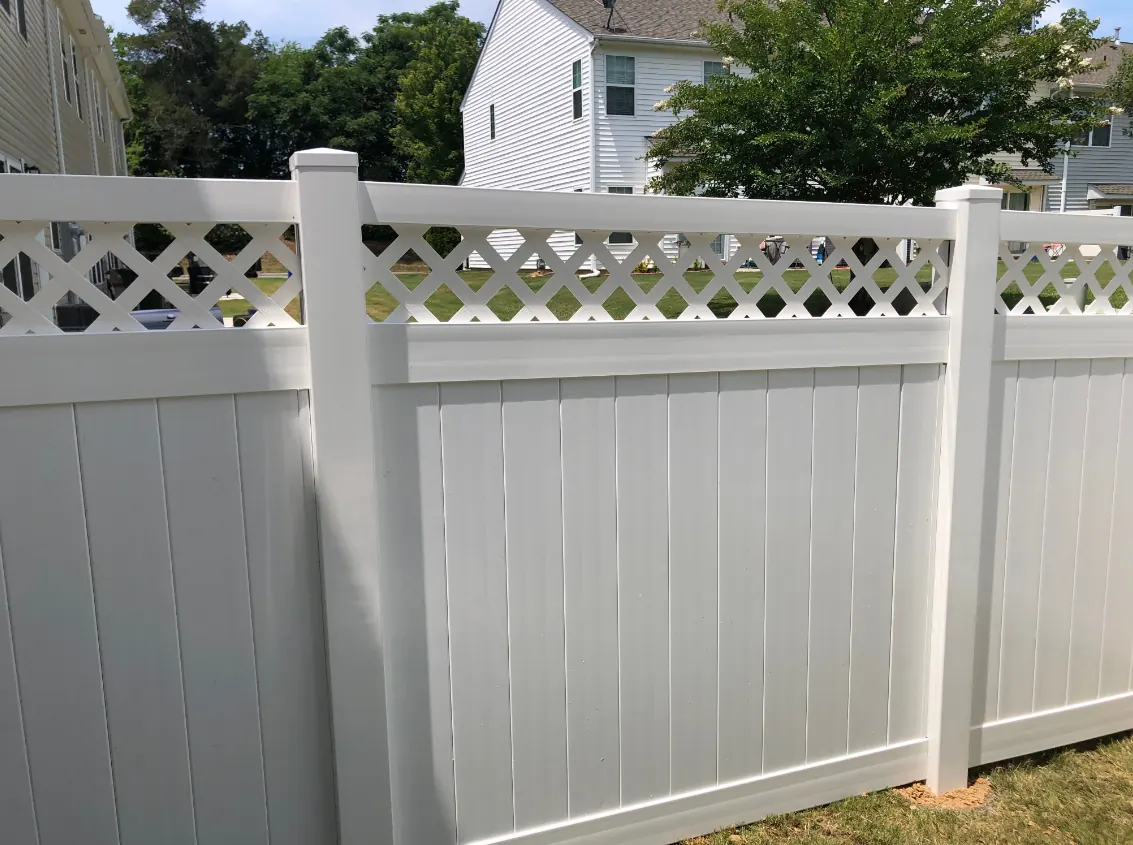
The lower part of the fence is ordinary privacy construction: vertical pickets on rails, closed to view. Above it sits a band of lattice, commonly about a foot tall, held in a frame between the posts. On a 6 ft fence that usually means around 5 ft of solid board with the lattice making up the rest.
The lattice changes how the fence feels more than how it performs. Light comes through the top, the skyline behind it stays visible, and the fence looks less like a wall from the patio. Privacy at standing eye level is slightly reduced, since the solid portion is shorter than on a full-height fence. For most seated and ground-level views it screens the same.
Lattice-Top Fences: Specifications
| Typical overall height | 6 ft including lattice |
|---|---|
| Lattice band | About 1 ft, framed on four sides |
| Lattice patterns | Diagonal, square, privacy spacing |
| Lower section | Solid vertical pickets |
| Top finish | Cap board over the lattice frame |
| Lumber | Pressure-treated pine or cedar |
Best Uses for Lattice-Top Fences
- Patios and outdoor seating areas
- Garden and courtyard boundaries
- Shared lines in HOA neighborhoods
- Small yards that feel closed in
- Homeowners who want a decorative top edge
Square, Diagonal and Privacy Lattice
Lattice comes in a few patterns, and the choice affects both the look and the amount of screening.
- Diagonal lattice: strips cross at an angle to form diamonds. This is the traditional garden look.
- Square lattice: strips run vertical and horizontal to form a grid. It reads as more tailored and pairs well with newer homes.
- Privacy lattice: the same patterns with strips set closer together, so the openings are small and less of the view gets through.
- Heavy-duty lattice: thicker strips than the thin sheets sold for skirting, which is what a fence top should be made from.
How the Lattice Section Gets Framed and Installed
Lattice is the weakest material on the fence, so the way it is held matters. We do not nail a loose sheet to the top of the pickets. The lattice is captured on all four sides in a frame, with a rail under it, a cap over it, and stops or a channel holding the edges. Framed that way, the thin strips are supported and cannot rack or flap in wind.
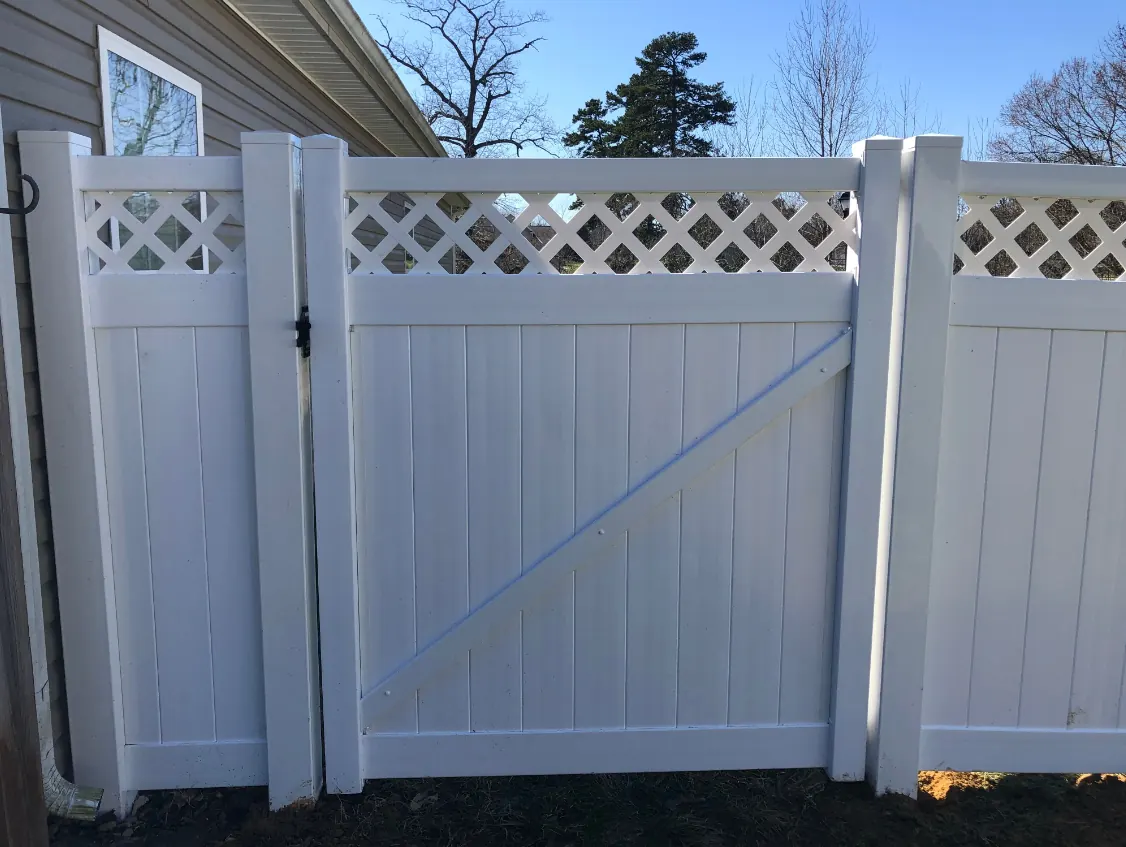
The rest of the installation follows the usual order. Utilities are marked, posts are set in concrete, and the rails and solid pickets go on. The posts run full height so the lattice frame fastens between them. A cap board finishes the top and sheds water off the frame. Gates carry the same lattice band so the line continues across the opening.
Replacing Lattice Alone or the Whole Fence
On an older lattice-top fence, the lattice normally goes first. Strips crack, staples rust out, and sections come loose from the frame while the boards below still have life in them. If the posts are solid and the pickets are sound, replacing only the lattice panels and cap is a reasonable repair.
Check the posts before deciding. Push on the fence at a few points along the run. If it rocks at the ground, or the rails have pulled away, new lattice on a failing frame will not last. Full replacement includes taking out the old fence and its concrete footings and rebuilding on new post holes. It is also a chance to change the lattice pattern or go to a heavier grade.
Lattice Tops in Charlotte HOAs and Humid Summers
This style shows up often in planned neighborhoods around Charlotte, Matthews and Ballantyne because it softens a 6 ft fence along a shared line. Associations frequently care about total height including the lattice, the pattern, and whether the fence has a cap. Bring us your design guidelines and we will match the specification, then provide what the architectural committee asks for with the application.
Humidity is hard on lattice. There are many small joints where water sits, and thin strips have little wood to spare. That is the reason we use heavier lattice and a cap. If you train vines on it, expect it to stay wetter and wear faster. Wisteria and other woody climbers can pry a lattice frame apart over a few seasons.
Height Planning for a Lattice-Top Fence
Decide early whether the lattice is part of the allowed height or on top of it. Where a fence is capped at a set height by zoning or covenants, the lattice normally counts, so the solid portion has to come down to make room. We confirm the limit for your address before drawing it up.
Think about what you are screening, too. If the concern is a neighbor's ground-floor windows or patio, 5 ft of solid board handles it. If their deck sits higher than your yard, the open band will be right at the sightline, and privacy lattice or a full solid fence is the better call.
Lattice-Top Fences: Photos From Our Jobs
These are our own installs. See more in the fence installation photo gallery.
Questions About Lattice-Top Fences
Does a lattice-top fence still give privacy?
Yes, for most situations. The solid section covers seated and ground-level views completely. The lattice band lets some view through at the very top, mostly for someone standing close or looking down from a raised deck. Privacy lattice, with smaller openings, narrows that further if it is a concern.
Does the lattice count toward the fence height limit?
In most cases the limit applies to the overall height of the fence, lattice included. Rules differ between Charlotte, nearby towns, the counties and individual HOAs, so there is no single answer for the whole metro. We check the requirement for your property before we finalize the design.
How long does the lattice last compared with the rest of the fence?
Lattice is thinner than the pickets and usually wears out first. Heavy-duty lattice, a full frame and a cap board all extend its life. If the lattice fails while the posts and boards are still sound, it can be replaced on its own without rebuilding the fence.
Which is better, square or diagonal lattice?
It comes down to the look of the house. Diagonal is the classic garden pattern and suits traditional homes. Square has cleaner lines and tends to suit newer construction. Performance is about the same when both are heavy-duty and properly framed. Your HOA may specify one, so check before choosing.
Can you add lattice to my existing fence?
Sometimes. It depends on whether the existing posts are tall enough and solid enough to carry a framed lattice section, and whether the added height is allowed. Fastening lattice to the tops of old pickets does not hold up. We would look at the fence in person before recommending it.
Is a lattice-top fence more expensive than a standard privacy fence?
Usually somewhat more. The lattice has to be framed, capped and fitted between posts, which adds material and carpentry time compared with running pickets to full height. The difference varies with the lattice grade and pattern. We provide a free written estimate once we have measured your fence line.
Can I grow vines on the lattice?
You can, with a caveat. Light annual vines do little harm. Woody climbers such as wisteria get heavy, hold moisture against the wood and can force the strips apart. If plants are the goal, tell us and we can talk about a sturdier trellis section built for the load.
Related Fences and Services
- Semi-Privacy Fences
- Dog-Ear Fences
- Garden Fences
- Decorative Fence Styles
- Wood Fencing Installation
- Residential Fence Installation
Areas We Serve
QC Fence Contractors installs and replaces fencing across the Charlotte metro in North Carolina and South Carolina. Pick the area closest to the property:
- Fence contractors in Belmont, NC
- Fence contractors in Huntersville, NC
- Fence contractors in Charlotte, NC
- Fence contractors in Matthews, NC
- Fence contractors in Ashbrook, NC
- Fence contractors in Harrisburg, NC
- Fence contractors in Concord, NC
- Fence contractors in Rock Hill, SC
- Fence contractors in Ballantyne, NC
- Fence contractors in Gastonia, NC
Listed under Wood Fence Styles in our full list of fence types we install.
Free Estimate: Lattice-Top Fences
Tell us about the property and what you want the fence to do. Or call (833) 691-3387.